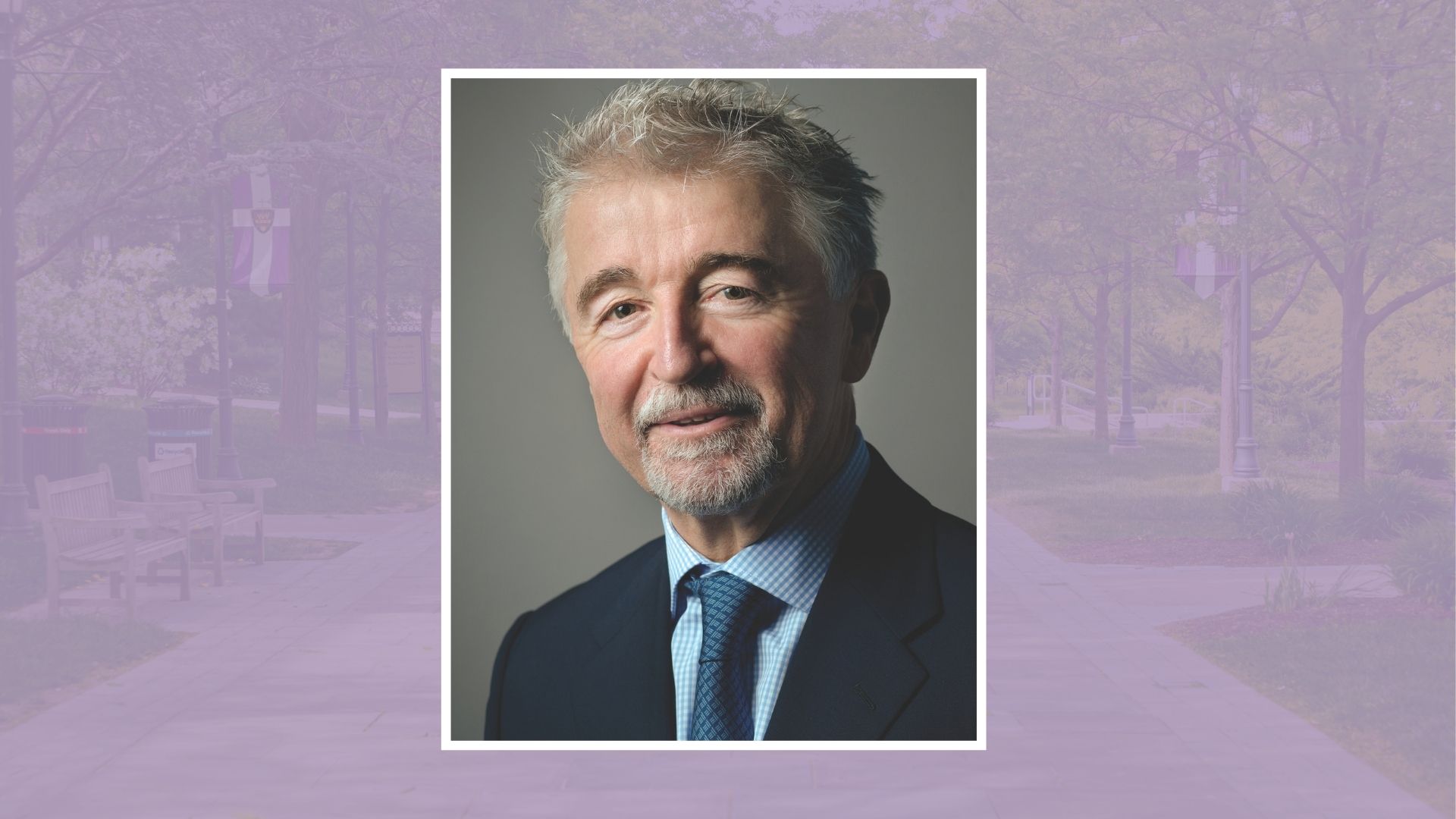
Pat McGeehin ’76 has an eye for opportunity.
A world-class expert in construction and government accounting and Who’s Who Legal’s 2017 Construction Expert Witness of the Year, McGeehin did not take the traditional steps early in his career. While the common approach when entering public accounting in the 1970s was to work on the audit staff for four to five years before considering specialization or moving to industry, he specialized within his first year out of school, a critical decision that irrevocably altered the trajectory of his career.
“The only advice I can give to anybody is keep your eyes open for the opportunity,” he said. “Easier said than done! I was fortunate enough to have an opportunity presented to me requiring specialization, and I took it. In hindsight, that was the critical decision leading to a long and productive career in consulting on government contracting matters and in providing expert testimony in the construction and government contract industries.”
And what a career it’s been. As a senior managing director in the Construction, Projects and Assets practice within the Forensic and Litigation consulting segment of FTI Consulting, Inc., he’s provided expert testimony in contract disputes and cost accounting to some of the most contentious construction projects in the world, including the Big Dig in Boston, and the more recent expansion of the Panama Canal.
“As an expert, I don’t say who’s right or wrong, but if you’re my client, I say, ‘If you’re right and entitled to damages, they owe you a certain amount of money – which can be in the hundreds of millions or even billions in some cases,’” he said.
Once upon a time in Scranton, however, he was a first-year accounting major riding in an elevator with the late Rev. Edward J. Gannon, S.J. H’83, who gave him a bit of unsolicited, but nevertheless invaluable, advice.
“Father Gannon said, ‘By the time you get out of here, you’re going to know how to write, and you’re going to know how to think,’” McGeehin said. “That always stuck with me because it was really true.”
While “testifying” on his education at Scranton, McGeehin said the University provided him with the balanced perspective and communication skills he needed to succeed in the business arena.
“You can be the best accountant in the world, but if you can’t communicate what you’re doing or talking about, what good is it?” he said. “Scranton, in my view, helped me hone those kinds of skills.”
With Highest Honor
As one of seven children from a blue-collar family in Hazleton, McGeehin knew his college search options were limited.
“It was, ‘Where can I go to school?’ ‘Well, wherever you get a scholarship,’ and that’s how we did it,” he said.
McGeehin’s natural talent for math helped him graduate at the top of his high school class, and a scholarship to the University ensured that he would follow in the footsteps of his late brother, Bob McGeehin ’72, G’74, at Scranton while blazing his own switchbacks for his siblings Michael McGeehin, Ph. D. ’77 and Molly McGeehin, CPA, ’81 to explore. He excelled academically at the University and joined an honors program that allowed him to take one-on-one courses with some of his professors, including a “Theatre of the Absurd” course with the late Stephen Ryan, Ph.D., which he enjoyed immensely.
“Scranton served me well,” he said. “I felt like I was a decent writer, but I became a better writer because I took so many humanities and English courses.”
After graduating summa cum laude, he moved to Philadelphia to begin working on the audit staff of a Big 8 accounting firm. It was there that he encountered a series of opportunities in which he had to discern the best way forward by trusting his intuition over the conventional wisdom of the day.
Opportunity Knocks
When Pat began working in Philadelphia, he quickly realized he was just “a number” on the audit staff at the firm. He earned his certified public accountant license and received a temporary assignment in Washington, D.C., working under Lou Rubino, a lawyer who handled government contracting consulting issues for the firm, including some litigation assignments. After establishing an immediate rapport, Rubino offered him a trainee position that would allow Pat to earn an MBA from George Washington University at night with emphasis in Procurement and Contracting, but it would also require him to move to Washington and abandon financial audits, which was seen as a risky move.
“The traditional advice at the time was, ‘No – you have to do four or five years on the audit staff, then you start selecting specialization and different career paths,’” he said. “Thankfully, I hated doing financial audits so was receptive for a change.”
Although he struggled with the decision, in the end, the opportunity to specialize, combined with a master’s degree funded by the firm, was too good for him to pass up. He married a woman he had known since the 9th grade, Roseann Eroh, and, two months later, they moved to Washington, D.C., which became their home for the next several decades.
At the time, the state of Maryland was both building the Baltimore subway system and renovating Baltimore’s international airport, and it had hired the Big 8 firm where Pat worked to monitor and review accounting records for the projects. Pat was assigned to these projects, and it gave him an up-close and personal glimpse into the inner workings of the construction and government contract sectors.
“They call this ‘forensic accounting,’ right?” he said. “In the construction industry at that time, they didn’t really call it ‘forensic accounting’ they called it, ‘Hey, maybe we should have an accountant look at the books?’ Now, this cottage industry has grown up over the years, and people focus and specialize in that area.
“I won’t pretend to have had some grand plan, or that I was going to set the stage for forensic accountants to be much more prevalent in the construction and government contract industry as it dealt with disputes, but it worked out that my career was parallel with the growth of this practice area for CPAs. I was lucky to get involved early on.”
Over a period of a few years where he developed good working relationships with clients and fellow employees, Pat found that he enjoyed the work, which made it easy for him to spot the next major opportunity that came his way: co-founding his own firm with Rubino.
Rubino & McGeehin
In 1979, Rubino told Pat he was planning to start his own consulting firm and asked Pat to come with him. While Pat admitted that his response was audacious, especially considering his age at the time (26), and the additional decade of professional experience Rubino had under his belt, it was another example of his ability to recognize the right opportunity at the right time.
“I said, ‘OK, but I’ll come as a partner,’” he said. “It just worked out splendidly. I am as proud of that relationship as I am with any other in my life, almost on a parallel with my marriage -- because in some ways, it’s actually harder to keep a long-term business relationship than it is to maintain a marriage.”
Given the positive experiences he’d had working with the state of Maryland, the firm then reached out to other state Departments of Transportation, and it was engaged over the years by many, including Pennsylvania, South Carolina and Massachusetts. This then expanded to working for construction companies, sureties and designers involved in disputes in the industry.
Little by little over the next 28 years, Rubino & McGeehin, including the Consulting Group where Pat spent most of his time, and the traditional audit and tax practice that was managed by others, grew from a glint in the eyes of the founding partners to a large D.C.-area CPA/Consulting firm with a strong reputation in the government contracts, construction and nonprofit sectors. His client list included large construction companies, U.S. Government agencies, State governments, and large aerospace companies, and Pat worked with some of the largest and most prestigious law firms in the U.S. and abroad.
In 2008, FTI Consulting acquired Rubino & McGeehin Consulting Group, and Pat moved on to his next opportunity as a senior managing director in the Construction, Projects and Assets practice within the Forensic and Litigation consulting segment of FTI.
The World of Quantum/Damages Litigation
While many might think of physics when they hear the word “quantum,” in Pat’s world, it’s a reference to the damages amount to be awarded – basically translated as "how much.”
“The quantum, the damages, the accounting, the cost allocations that go into the amount being disputed in the construction and government contract industries – that’s where my expertise developed,” he said.
In an arena where millions or billions of dollars are often on the line, his testimony can be critical to the outcome of a case, and opposing counsel and experts often take positions that contradict and challenge Pat’s positions.
“When you get into these things, it’s very stressful and it’s very contentious,” he said. “The lawyers are typically very bright, especially on the very large cases, but can get aggressive – viewing their job as one where they need to try and attack the expert’s credibility and calculations.”
Still, Pat believes the highest compliment his work can receive comes when the opposing counsel from a previous case later provides a referral and his or her client hires him on a subsequent project.
“If you’re hired by a lawyer who was cross-examining you on a prior case, that means that they’ve found you to be credible, and they’d rather have you with them than against them,” he said.
As a clear indication of Pat’s industry successes and recognition, he was asked to co-edit an American Bar Association (ABA) book, “Construction Accounting: A Guide for Attorneys and Other Professionals,” a resource the ABA recommends as a “useful reference on the more detailed and complicated financial topics that a construction lawyer may be called upon to handle.” Pat was the accounting editor for that publication and co-wrote a chapter of the book. He was joined on the editorial board by several lawyers in the construction industry.
The Next Opportunity
At FTI, Pat is winding down and preparing for retirement. He is able to work remotely most of the time and is no longer taking on new cases where he is the testifier.
“This time next year, I’m hoping to be able to tell you I’m basically done,” he said, although he may still have a case or two that is straggling into late 2027 or 2028. “Given that we have been working for several years on many of the cases I am involved with, it is not like you can decide one day that you are finished and will not testify anymore. I still have ongoing commitments to my clients on several cases.”
As they approach their 50th wedding anniversary, he and Roseann enjoy splitting their time between their residences in New York City, Bethany Beach, Delaware, and Asheville, North Carolina, whose mountains and wildlife remind him of his boyhood in Hazleton.
“You can smell the rain coming when you are in the mountains and the woods,” he said. “I kind of like that.”
After 50 years of spotting the next opportunity a few steps ahead of the game, his recent gift to The Magis Fund through The Estate Society proves that he’s eager to help create opportunities for the next generation of Royals.
“I’ve always been cognizant and appreciative of my Scranton education, so this seemed like a good way to give something back,” he said.
As a bit of parting wisdom, he stressed the importance of looking ahead to the next opportunity and moving forward one step at a time.
“Keep an open mind,” he said. “Make sure you’re always open to that opportunity.
“Say to yourself, ‘Could this work for me?’ Other than that, you just have to trust your instincts and try to make good decisions one at a time. Don’t try to hit that home run every time ---- hit a couple singles and keep the game going. And, as Father Gannon told me over 50 years ago, learn how to write!”